AWS Static Website Hosting and Secure Web Application Deployment Architecture
Designed and deployed a scalable AWS-hosted web application platform combining static website hosting, containerized workloads, CDN delivery, and layered security services.
Implemented: June 2022
Problem
The client required a modern cloud-based hosting architecture capable of supporting both static web content and dynamic application workloads with high availability, scalability, and security.
The platform needed to provide:
- Reliable static website hosting
- Global content delivery performance
- Secure public access over HTTPS
- Scalable backend application hosting
- Centralized monitoring and auditing
- Managed database and caching services
Solution
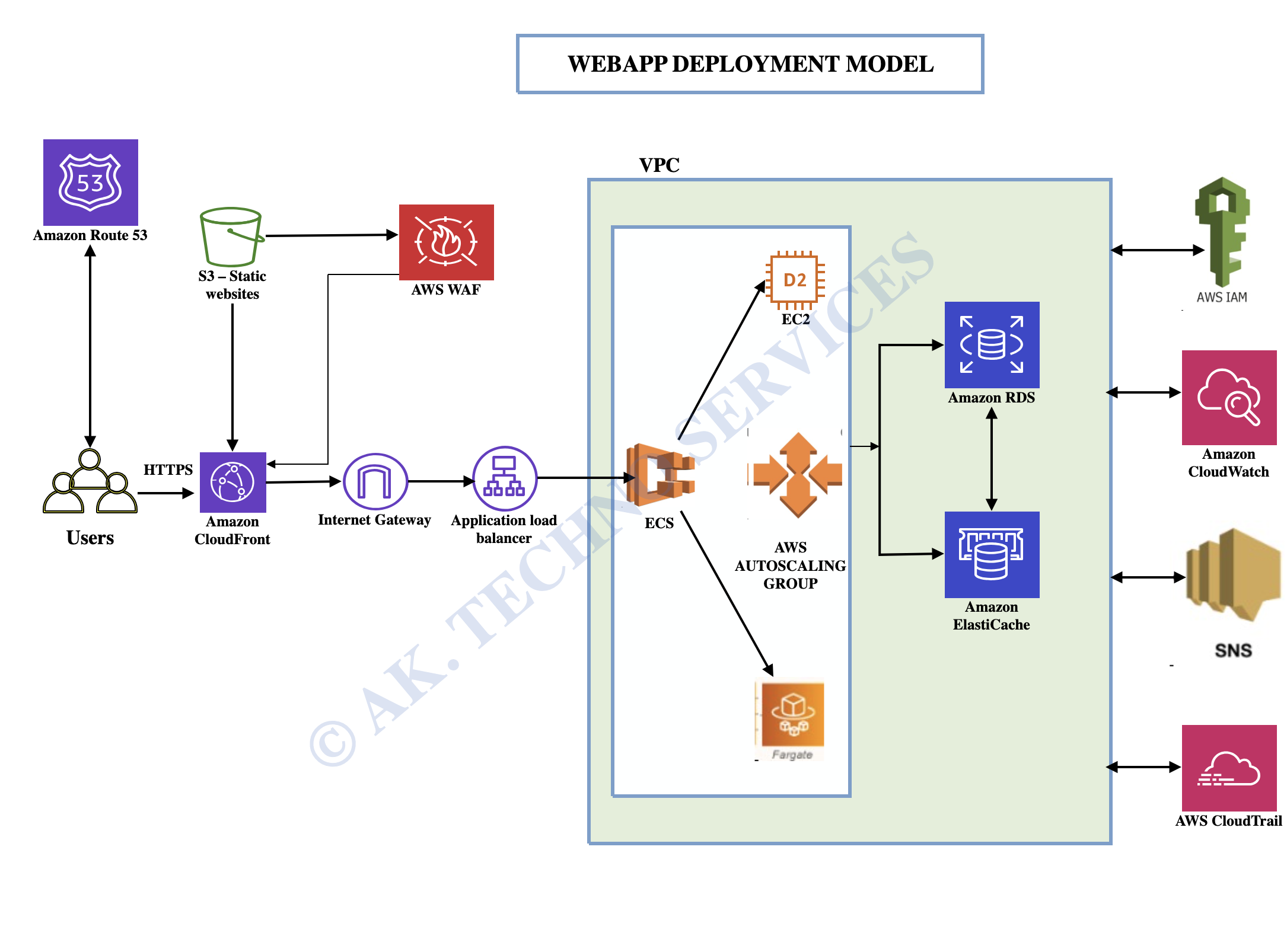
Designed and implemented a layered AWS web application architecture using Amazon S3 for static website hosting, Amazon Route 53 for DNS management, and Amazon CloudFront for global content delivery.
AWS WAF was introduced to provide edge-layer protection and filter malicious web traffic before requests reached backend services.
Containerized application workloads were deployed on Amazon ECS using both EC2-backed clusters and AWS Fargate for workload flexibility and scalability. Traffic routing was managed through an Application Load Balancer within a dedicated VPC.
The backend application layer integrated Amazon RDS for managed relational database services and Amazon ElastiCache to improve application performance and reduce database load.
Operational visibility and governance were enhanced using AWS CloudWatch, CloudTrail, SNS, and IAM.
Architecture
- Users accessed the platform securely over HTTPS.
- Amazon Route 53 handled DNS resolution for the application domain.
- Static web content was hosted within Amazon S3 and distributed globally through Amazon CloudFront.
- AWS WAF filtered inbound requests and provided web-layer protection.
- Traffic entered the VPC through an Internet Gateway and was routed via an Application Load Balancer.
- Backend application services ran on Amazon ECS using EC2 instances and AWS Fargate containers.
- Application services communicated with Amazon RDS and Amazon ElastiCache for persistent storage and caching.
- Monitoring, auditing, and operational alerting were managed using CloudWatch, CloudTrail, SNS, and IAM policies.
Tech Stack
Amazon S3 • Amazon Route 53 • Amazon CloudFront • AWS WAF • Amazon ECS • AWS Fargate • Amazon EC2 • Amazon RDS • Amazon ElastiCache • AWS IAM • AWS CloudWatch • AWS CloudTrail • Amazon SNS
Outcome
The implementation delivered a secure, scalable, and highly available hosting platform capable of supporting both static and dynamic workloads within AWS.
The architecture improved website performance through CDN acceleration, strengthened perimeter security using WAF controls, and provided operational visibility through centralized monitoring and audit services.
The modular design also established a scalable cloud foundation capable of supporting future application growth and service expansion.
Key Takeaways
- Combined static content delivery and containerized backend services within a unified AWS architecture.
- Improved application security posture using AWS WAF, IAM governance, and CloudTrail auditing.
- Enhanced scalability and performance using CloudFront CDN distribution and ElastiCache integration.
- Future enhancements could include Infrastructure as Code, autoscaling optimization, and blue/green deployment strategies.
Reflection
If extending the platform today, I would integrate Terraform or AWS CDK for automated infrastructure provisioning, implement zero-trust access controls, and introduce centralized security monitoring through AWS Security Hub and GuardDuty for deeper operational visibility.