Read-Only Domain Controller (RODC) Deployment for Distributed Authentication Resilience
Implemented a Read-Only Domain Controller (RODC) solution to improve authentication availability, reduce branch-site dependency on core infrastructure, and strengthen Active Directory security.
Implemented: July 2016
Problem
The organization required improved authentication resilience for remote and distributed users while reducing the security exposure associated with deploying full writable domain controllers in less secure network locations.
The existing environment relied heavily on centralized writable domain controllers, creating authentication dependency risks during WAN outages and increasing the attack surface for Active Directory replication.
Solution
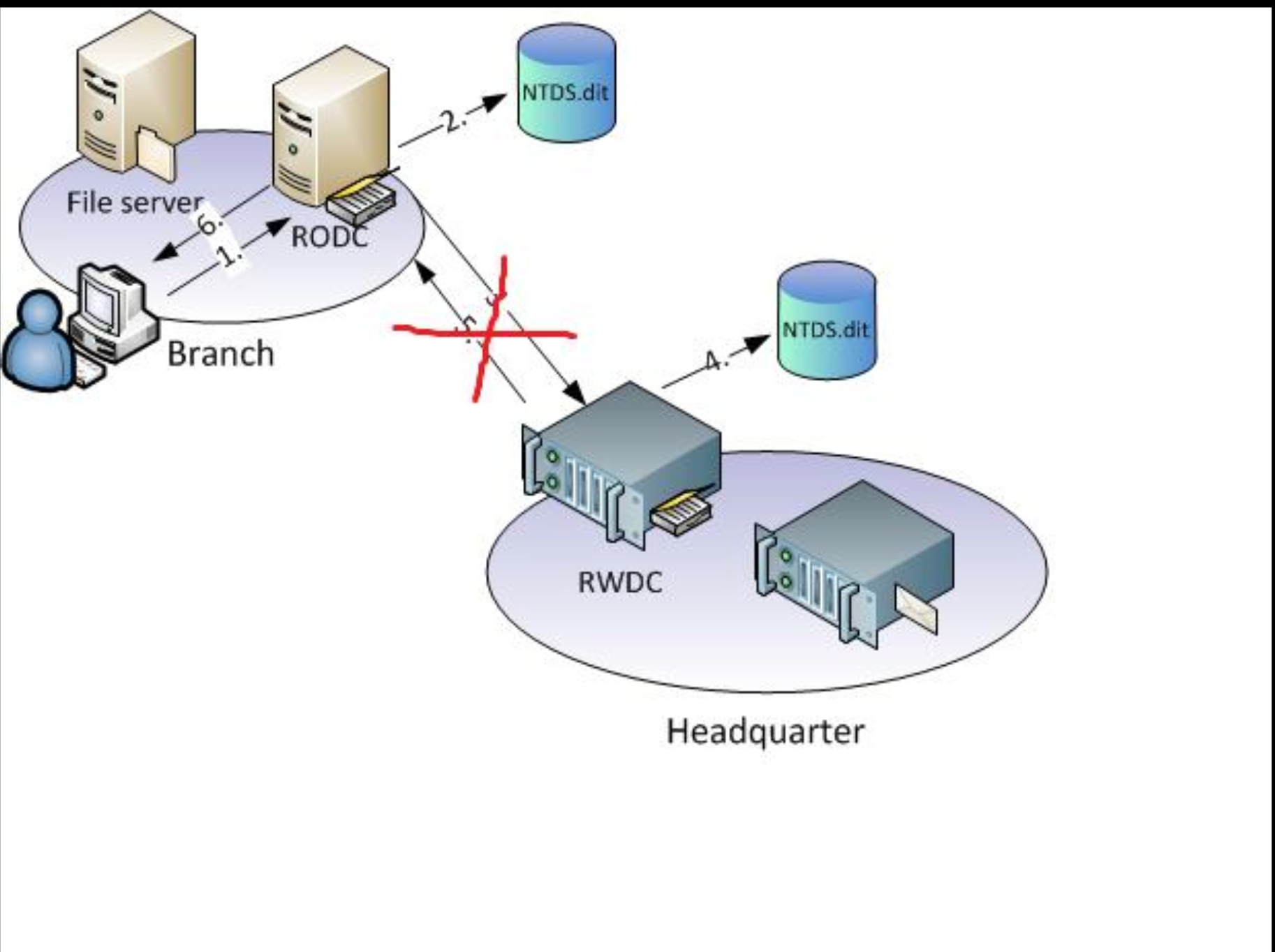
Designed and deployed a Microsoft Read-Only Domain Controller (RODC) infrastructure to provide localized authentication services while maintaining centralized Active Directory control.
The implementation introduced controlled Active Directory replication from writable domain controllers to the RODC, enabling users to authenticate locally during WAN interruptions without exposing full directory write capabilities at the remote site.
Password Replication Policies (PRP) were configured to control credential caching and limit sensitive account exposure on the RODC. DNS and Active Directory Domain Services were integrated to maintain authentication continuity and domain resolution.
Architecture
- Primary writable Domain Controllers remained hosted within the core data center environment.
- The RODC was deployed at the remote/branch site for localized authentication services.
- Active Directory replication flowed one-way from writable DCs to the RODC.
- Password Replication Policies controlled which credentials could be cached locally.
- Remote users authenticated against the RODC during WAN degradation or outages.
- DNS services integrated with Active Directory to support local authentication resolution.
Outcome
The deployment improved authentication availability for distributed users while reducing operational dependency on constant WAN connectivity.
The RODC design further strengthened security by limiting credential exposure and preventing unauthorized directory modifications at remote locations.
Key Takeaways
- RODCs improve branch-site authentication resilience without exposing full AD write functionality.
- Password Replication Policies help minimize credential exposure at remote locations.
- One-way AD replication strengthens security boundaries for distributed infrastructure.
- Future iterations should include monitoring, replication health automation, and SIEM integration.
Reflection
Future improvements would focus on integrating automated replication monitoring, centralized logging, and hybrid identity integration with cloud-based authentication services.