Enterprise LAN Topology Upgrade with Sophos Firewall Integration
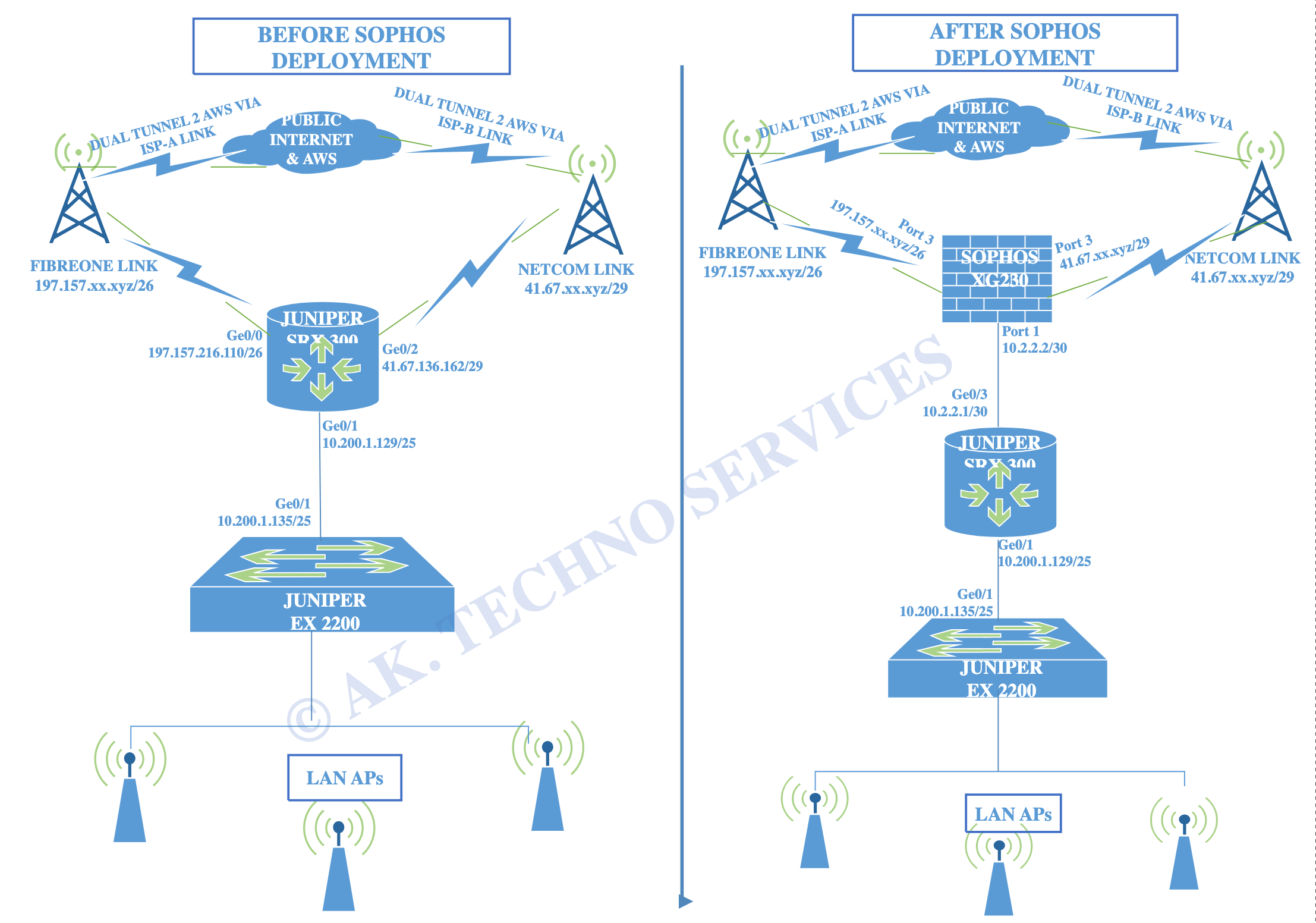
Migrated a legacy 2-tier LAN architecture to a scalable 3-tier network design with centralized security enforcement using Sophos Firewall.
Implemented: May 2019
Problem
The existing 2-tier network architecture had limited scalability, weak segmentation, and minimal centralized security controls. As the environment grew, managing broadcast domains, enforcing access policies, and maintaining network performance became increasingly difficult.
Solution
Redesigned the LAN infrastructure into a 3-tier hierarchical topology consisting of Core, Distribution, and Access layers. Integrated a Sophos Firewall to centralize perimeter security, traffic inspection, and policy enforcement.
The implementation focused on improving scalability, network segmentation, redundancy readiness, and overall security posture while minimizing disruption to existing operations.
Architecture
- Core Layer handled high-speed backbone connectivity between network segments.
- Distribution Layer enforced routing, VLAN segmentation, and inter-VLAN traffic control.
- Access Layer connected endpoint devices and user networks.
- Sophos Firewall provided perimeter protection, access control, and traffic filtering between internal and external networks.
- VLAN segmentation was introduced to separate users, services, and administrative traffic.
Outcome
The upgraded architecture improved network scalability, simplified traffic management, and strengthened security controls across the environment. The introduction of structured network layers also improved maintainability and prepared the infrastructure for future expansion.
Key Takeaways
- Migrating to a 3-tier topology improves scalability and operational clarity.
- VLAN segmentation reduces broadcast traffic and strengthens internal isolation.
- Centralized firewall enforcement simplifies security policy management.
- Future iterations should include redundancy mechanisms and monitoring automation.
Reflection
Future improvements would include high-availability firewall deployment, dynamic routing integration, and centralized network monitoring for better visibility and resilience.