Active/Passive Disaster Recovery Architecture Across AWS Regions
Designed and implemented a multi-region Active/Passive disaster recovery strategy to improve business continuity, service resilience, and recovery readiness for critical cloud workloads.
Implemented: June 2022
Problem
The client required a disaster recovery solution capable of maintaining service continuity during regional outages or major infrastructure failures within AWS.
The existing environment lacked a structured failover strategy, creating risks around:
- Regional service disruption
- Extended downtime during outages
- Data availability concerns
- Operational recovery complexity
- Limited resilience for production workloads
The organization needed a cost-conscious DR model that balanced availability requirements with infrastructure overhead.
Solution
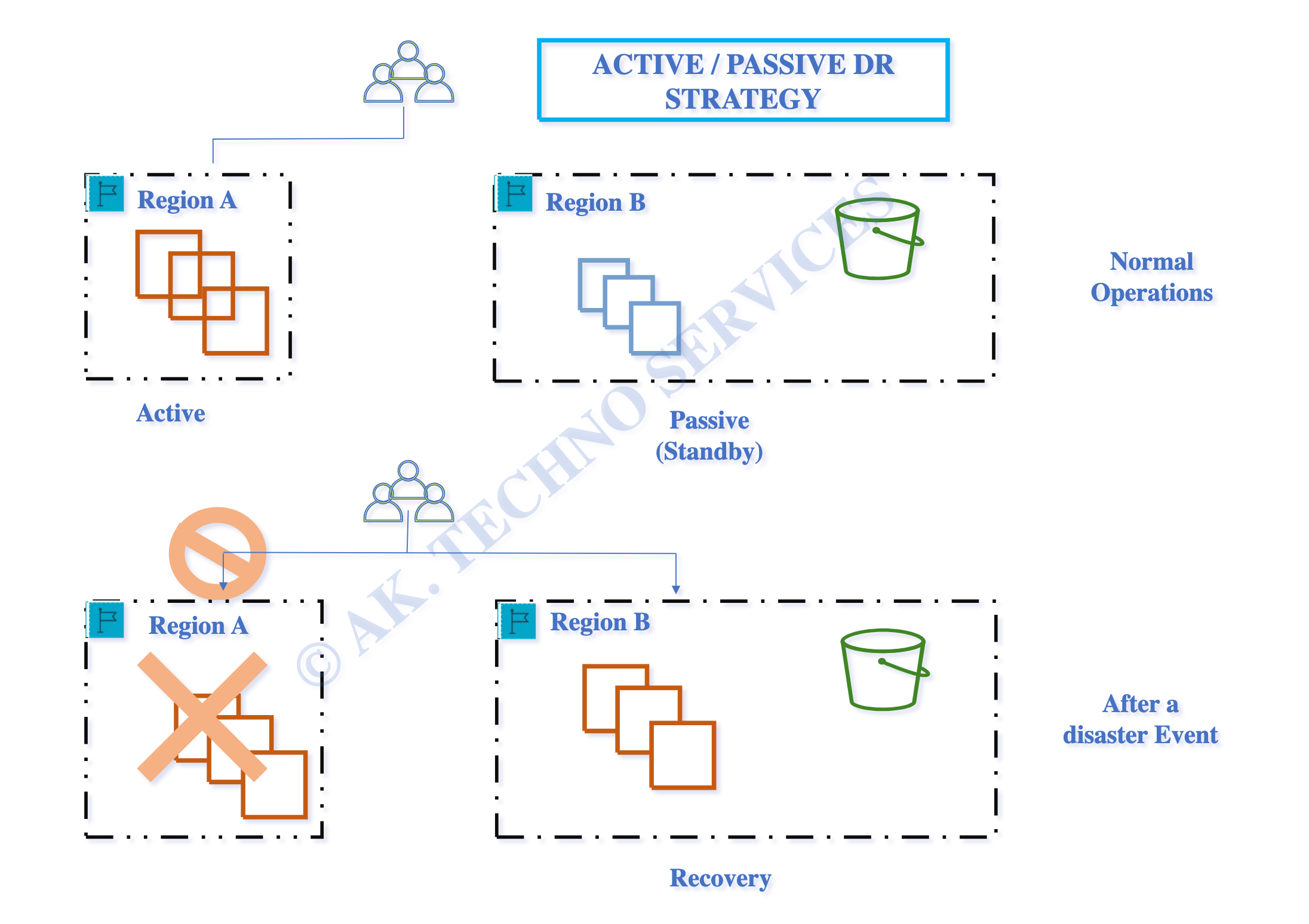
Designed and implemented an Active/Passive disaster recovery architecture spanning two AWS regions.
The primary production environment operated in the active region, while a secondary standby environment was maintained in a passive state within a separate AWS region. Critical application components, storage layers, and recovery resources were replicated and synchronized to support controlled failover operations during disaster scenarios.
The passive region was designed to remain operationally lightweight during normal operations while maintaining sufficient readiness to assume production workloads when required.
The solution established documented recovery procedures, regional failover workflows, and recovery validation processes to improve organizational resilience.
Architecture
- Production workloads operated from the primary AWS region under normal conditions.
- Critical application data and supporting resources were replicated to a secondary standby region.
- The passive region maintained synchronized infrastructure components in a standby state.
- During a regional outage or disaster event, user traffic and workloads were redirected to the secondary region.
- The passive environment transitioned into an active production role to restore service continuity.
- Recovery workflows supported controlled restoration and failback operations once the primary region became available again.
Tech Stack
AWS Multi-Region Architecture • Amazon S3 • Amazon EC2 • Disaster Recovery Strategy • AWS Networking • Failover Design • Business Continuity Planning • Cloud Resilience Engineering
Outcome
The implementation improved the client’s operational resilience by introducing a structured disaster recovery capability with regional failover support.
The architecture reduced recovery risks, improved business continuity preparedness, and established a scalable DR framework aligned with cloud-native resilience principles.
The Active/Passive model also optimized infrastructure costs by limiting full-scale active resource consumption within the standby region during normal operations.
Key Takeaways
- Designed a regional failover strategy to improve service continuity and disaster preparedness.
- Balanced resilience requirements with cost optimization through an Active/Passive deployment model.
- Improved recovery readiness through standby infrastructure synchronization and documented failover procedures.
- Future enhancements could include automated failover orchestration, Route 53 health checks, and Infrastructure as Code recovery automation.
Reflection
If expanding the implementation today, I would introduce automated cross-region failover workflows, continuous recovery testing, and centralized observability dashboards to improve recovery confidence, response time, and operational visibility during disaster events.